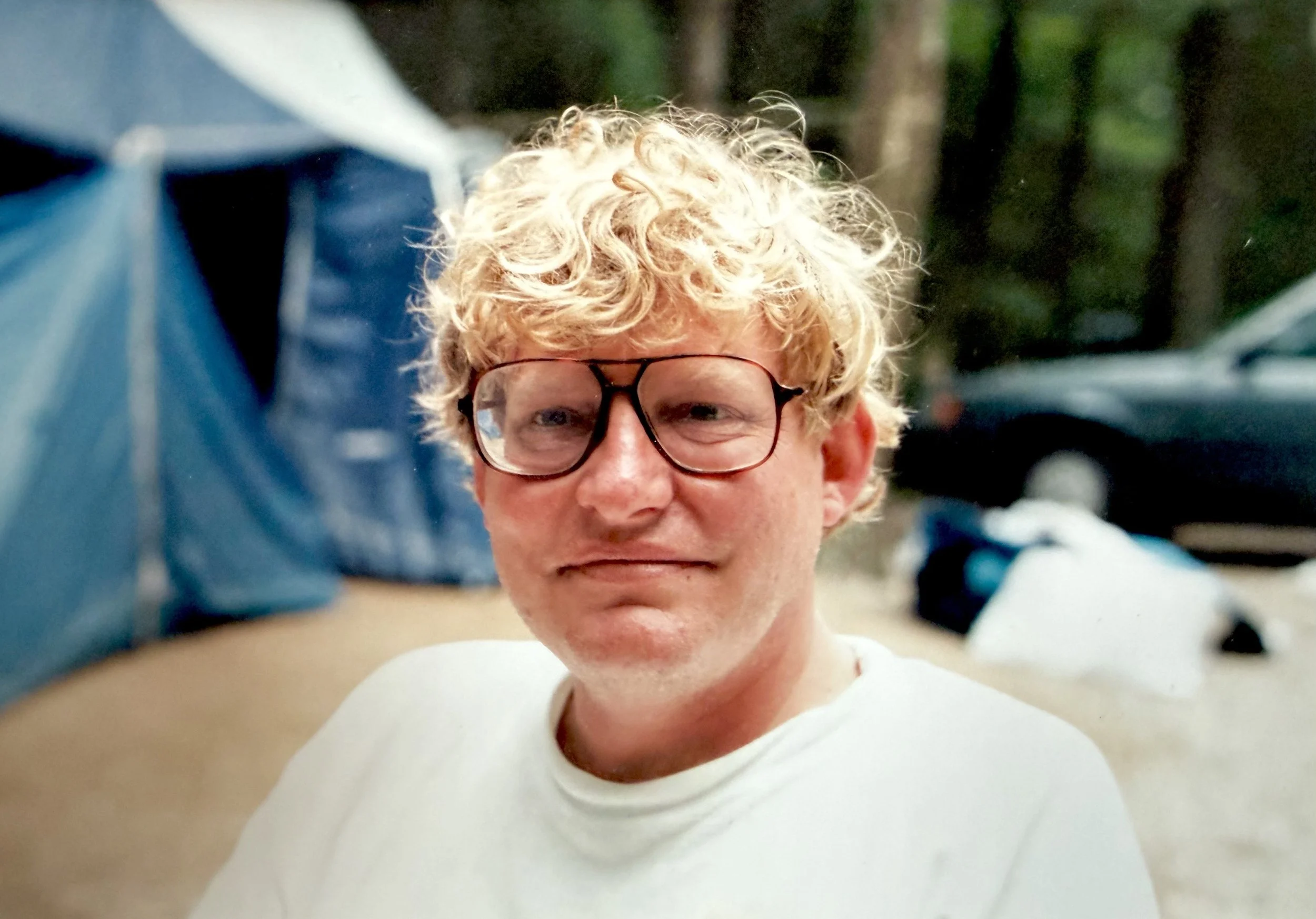
My 50 Year Friendship With Peter Murdoch
In September 1975, over 50 years ago, I was a 25 year old, mild-mannered reporter driving around southern Ontario looking for a job. I walked into the office of the Port Hope Evening Guide, the smallest daily newspaper in Canada, and as I shook the hand of the editor, Peter Murdoch, I experienced one of those strange intuitions that a lasting friendship was in the cards; that we were going the distance.
Four years older, Peter felt like a benign big brother: mature, confident, athletic, sophisticated, a born leader with a quick wit, a ready laugh and an unruly mop of blond hair. He gave me my own opinion column to unleash my own bent humour, which proved liberating, for in truth I wanted to be a writer, not a reporter.
I met his wife Lynda and liked her immediately. I spent a lot of time at their shambolic farm house outside of town, the first in a lifelong string of fixer-upper homes that never got fully fixed. I called him Farmer Murdoch and we hung out with a lively circle of off-beat characters--poker and pinball games, Halloween costume parties, amateur theatricals, drinking and laughing, doing those impulsive, mischievous things that 20-somethings do.
On Leap Year Day, February 29, 1976, Peter thought it was a good idea that we smoke up and shoot the rapids of the Ganaraska River in a canoe, echoing a scene of out the film Deliverance, minus the hillbilly banjo music.
Everything was going swimmingly until we hit a wire fence strung across the river and tipped over into the rushing current. With freezing water up to our chests, we screamed and hyperventilated in unison, staggering up on the banks as the sun set. Flirting with hypothermia, we wandered through the dark, snowy woods until we found the house of a farmer who revived us with shots of scotch.
Waiting for us at the Port Hope bridge at the mouth of Lake Ontario, Lynda and my girlfriend Connie understandably feared the worst when we never showed up. When they arrived to pick us up -- if looks could kill! -- I was perched by the fireplace in the dressing gown of the farmer’s wife, suitably humiliated.
That spring, Peter, myself and a fellow reporter impulsively raced down to the Kentucky Derby, sleeping overnight in the car. It was a wild time -- Peter and Lynda watched a UFO hovering over their property, then Peter witnessed a gangland murder in the local bar. A radon gas scandal caused by the town’s Eldorado Nuclear refinery was drawing international attention and Peter was interviewed by NBC-TV. Sleepy Port Hope was anything but sleepy.
As I got to know him better, I was intrigued by Peter’s trajectory from his birth in a Lancashire village in 1946 into a first wave boomer student radical. As an officer with the Seaforth Highlanders, his father helped plan the Canadian army’s liberation of Holland and directed the rescue of the population from starvation while his blonde, glamourous mother worked for the RAF as a decoder at the legendary Biggin Hill fighter base and packed a derringer. Earning an OBE, his father rose to the post-war rank of Brigadier-General while Peter and his older brother Scott rotated through assorted army bases in England, Germany and Canada, surrounded by parade ground drills and saluting chauffeurs. The archetypal “army brat”, he came by his subversive side honestly.
In his Ottawa high school, Peter formed a rock band and recorded a cover version of “Walking the Dog.” As captain of the basketball team, they won the city championship. As the second born, Peter was supposed to be a girl, named Margaret after his mother, which may explain the feminine and pacifist side of his complex character.
In 1967, as a University of Western Ontario undergrad, he joined the newly formed Company of Young Canadians, devoting himself to social work and political activism, ranging from the noble to ignoble, from championing welfare mothers in street protests to sending a box of shit to a university president.
In Port Hope, our friendship grew on the foundation of a shared irreverence and a suspicion of materialistic bubbles of privilege. It was part of our class privilege to be able to criticize our class privilege—eat our cake and spit it out. After only nine months, I quit the paper, swept up by another of Peter’s bold ideas. He wanted to start up a progressive, free distribution tabloid paper in Toronto covering politics and entertainment, a precursor of NOW magazine. It was an idea ahead of its time and when it didn’t pan out, I moved into book publishing and he moved to newspapers in Peterborough, Ottawa and Hamilton. But the friendship persisted.
Weird little coincidences intersected our lives. We discovered that as students at Western, we had rented the same digs at 646 Talbot Street, just a few years apart. In 1978, his first child Alyson was born on my birthday, September 16, and I was honoured to be named her Godfather. A son, Jake, a derivative of James, arrived three years later and I made a regular weekend bus trips to their home in Dundas in the 1980s and ‘90s, a single guy adopted by the family, basking in the ritual dog walks in the conservation area, Jake’s hockey games, and lively dinners and card games. Another coincidence popped up when I discovered that my maternal grandmother grew up in house on Melville Street, just one block away.
When I was researching my paternal family roots, I discovered that my Irish ancestors landed in Port Hope in 1824 and settled a few miles north of the lake. When Peter helped me find the graves of my great-great-grandparents, I was struck by a mystical feeling that my own seemingly random landing in Port Hope in 1975, and meeting Peter, was mysteriously pre-ordained. Something about my nine-month gestation period in Port Hope made me feel “at home.” Hopeful.
In 1990, Peter moved out of print journalism to join the Communications, Energy and Paperworkers Union,(CEP), putting his sophisticated political intellect and Sixties socialist idealism to work. Dragging the kids to the annual Labour Day parade, he was a social justice warrior before it became a household phrase. But he was not a rigid ideologue, either; I was always impressed how always thought for himself, challenging received wisdoms on the left and the right.
I enjoyed his stories of the rigours of unionizing newsrooms. At a Southam stockholders meeting, he mounted the stage to confront the media baron Conrad Black. Peter had once memorably characterized one of Black’s henchmen as “a wolf in wolf’s clothing”, so they were entrenched adversaries. As Black ceded the microphone, he sighed: “Ah, the inevitable Mr. Murdoch.” Ironically, the Marxist owners of NOW magazine fought his unionizing efforts tooth and nail; Peter said they were harder to handle than Conrad, the black capitalist.
While the breakup of his marriage was a painful setback, Peter remained a devoted father. When he was diagnosed with a life-threatening case of melanoma in the ‘90s, he saw it as a wake-up call, re-set his life, and beat the odds. In a lighter moment, he conceived The Rosseau Group, a mock think tank where over beers a bunch of us would float wild and crazy entrepreneurial ideas, writing TV scripts that went nowhere, and so on. He dreamt up a promotion for the Toronto Maple Leaf hockey games in which Zambonis raced on the ice between periods, and he actually got as far as a meeting with their general manager.
In 2008, he published an article in the Toronto Star reporting on his trip to war-torn Baghdad. As part of a CEP delegation, he addressed the killing of journalists and the rebuilding of an independent media and civil society in Iraq. A braver man than me, and I told him so.
In his retirement, he wrote a children’s book as a legacy for his four grandkids. “The Frogs on Stevens Creek” taught kids how love and compassion can disarm bullies, ending with the tagline: “Keep hoping, keep hopping.” He revisited his “Walking the Dog” rock band high school days when he composed two pop songs and hired local musicians to cut the tracks in a studio. The songs, “Idaho” and “Dot Com”, now live on the internet, and they are damn good.
Starting in Port Hope, Peter was a seminal influence in my slow transition from a reporter to a writer with my own voice; I will always remain grateful for his unflagging emotional support as I struggled to establish myself as a book author, finally succeeding at age 44. One day in the early 90s, I confessed how I was wrestling with my first book, a collection of oral histories of the “old boys” of Upper Canada College, agonizing over whether I was performing conventional journalism, history, or just crap. When he said it was a “work of art”, something clicked over inside me. In that moment, I dared to think of myself as an artist.
In 2000, Peter donated, rent free, a union office on Queen Street East, to promote the work of budding artists. For two years, “Art At the Union” served as a dynamic hub for art shows, lectures and music. The venue proved instrumental in launching the career of a gifted, 24 year old painter and filmmaker, Margaux Williamson, who gradually achieved international stature with shows at the AGO, the McMichael , and galleries abroad. Peter knew talent when he saw it.
https://collectivecity.ca/art-collectives-in-toronto/art-at-the-union/
Like most of us, Peter’s gifts were entangled with his flaws. He could be his own worst enemy, not just subversive but self-subversive. We shared a propensity for frustrating and undermining the various women in our lives, reflexively deflecting the deeper intimacies we craved. Averse to acknowledging birthdays, he felt more comfortable giving than receiving. Sometimes an explosive temper erupted, without apology. About 20 years ago, our friendship nearly splintered during an intense argument over his coarse treatment of a mutual friend; we bent but we did not break.
His final years were a trial. I’m not sure how he persevered, and it was no picnic for those around him. His addiction to alcohol — and the occasional masochistic foray to the casino — undermined his medical care. When he could no longer walk unaided, he kept fantasizing about taking a solo road trip to Las Vegas — shades of our youthful gallop off to the Kentucky Derby. At one point, he ruminated that his childhood was not as rosy as he originally thought. Even as he winced with pain from an assortment of ailments, he’d cheerlead my own ongoing creative efforts and started writing a play about two MAGA types whose hunting and fishing trip to Canada changes their lives. Even as his body deserted him, his mind remained sharp; he kept on hoping, kept on hopping: “This may sound arrogant, but I’m the son of a general.” In the fall of 2025, just weeks before his death, I was glad he was able to grab a patch of joy watching the Blue Jays on their magical World Series run.
Peter’s complex web of traits could fill a thesaurus: skeptical, mercurial, witty, canny, generous, exasperating, charming, angry, ethical, playful, provocative. A Scots-blooded contrarian, a philosopher king, a Peter Pan, a left-handed leftist, a rogue scholar, an entrepreneurial socialist, a merry prankster, a loner and a care-taker. Having a beer and kicking around ideas, inspiring and catalyzing others, was the main event; actually following through was not as important. Once I understood that, I just went with it. To the end, he was a gloriously Bohemian slob; I never saw him wear a suit and tie — a man after my own heart.
In his last months, enduring his physical agony with Protestant stoicism, he described his intensifying dream life as “explosions in the mist.” In one powerful dream, he felt a coat of armour falling away from his heart, revealing the word “love.” A few days later, a young woman arrived in the retirement home to administer a 40 minute psychological multiple choice test, ranking answers on a scale of 1 to 10. Predictably, Peter scolded her: “You don’t know who I am.” Then he related his heart/love dream and she burst into tears. “Now you know,” he said, “who I am.”
We all share passage in the same rocking boat, struggling our whole lives to love and be loved; yet, after his death, Peter instructed his family not to hold a memorial. I thought to myself: “Peter, come on, funerals are important. Funerals are for the living.”
Knowing Peter Murdoch could be both sunny and rocky. Such is the privilege of a friendship that goes the distance: if we allow ourselves to experience our best and worst selves, we may learn to accept them both. He contained multitudes, and I’ll miss him.
Peter Ross Murdoch, journalist, activist, union organizer, philosopher king.
Born May 18, 1946, in Turton, Lancashire; died December 20, 2025, in Hamilton, Ontario, of influenza, aged 79.